Whole Child Curriculum
A Whole Child Curriculum
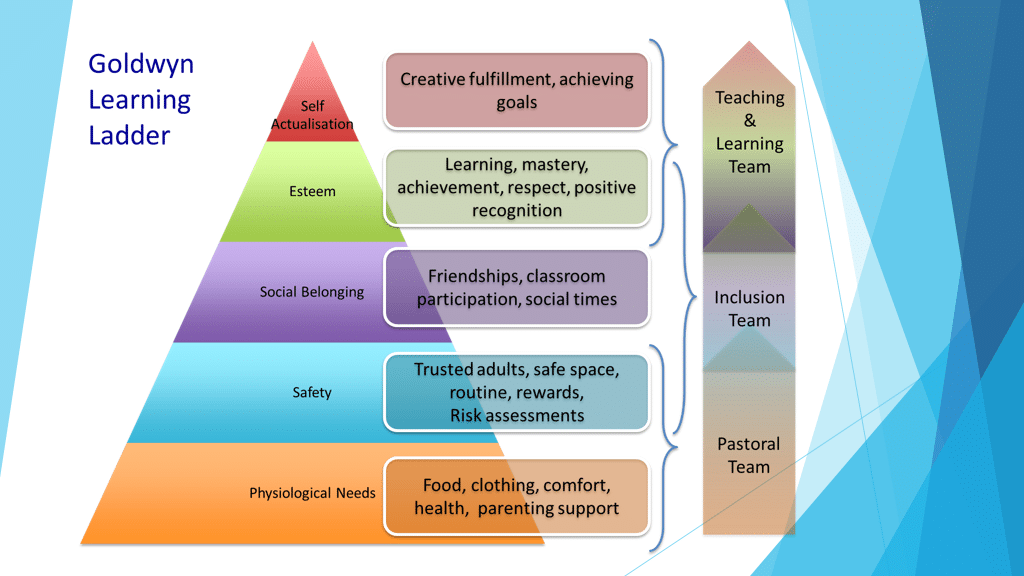
At Goldwyn, we believe that education must do more than deliver qualifications — it must develop the whole child. Our Whole Child Curriculum has been carefully planned and continuously evolved to balance academic ambition, meaningful qualifications and future career pathways alongside a deep commitment to social and emotional development, nurture, self-esteem and self-actualisation.
Our curriculum is designed to directly address the barriers identified in pupils’ Education, Health and Care Plans (EHCPs), ensuring that learning is personalised, purposeful and accessible. We are incredibly proud of the young people who leave Goldwyn — confident, resilient and equipped not only with knowledge, but with the skills, values and self-belief needed to contribute positively to the world around them.
Evidence-Led, Research-Informed Practice
Our Whole Child Curriculum is rooted in evidence-led practice, drawing together well-researched approaches that are proven to improve outcomes for children with SEMH and additional needs. These approaches are not delivered in isolation; they are deliberately woven together to create a coherent, consistent and inclusive learning experience.
Trauma-Informed Practice
We recognise that many of our pupils have experienced adversity or disrupted attachments. Our trauma-informed approach prioritises emotional safety, predictable routines, strong relationships and regulation before learning. By reducing stress and threat, we enable pupils to engage, take risks and thrive academically and socially.
Nurture Principles
Nurture underpins our curriculum design and daily practice. We focus on building secure relationships, promoting emotional literacy, recognising behaviour as communication and providing developmentally appropriate support. Through nurture, pupils build trust, confidence and a sense of belonging — essential foundations for learning.
Metacognition
We explicitly teach pupils how to learn. Through metacognitive strategies, pupils are supported to plan, monitor and evaluate their own learning, helping them to develop independence, self-reflection and resilience. This empowers pupils to understand their strengths, overcome challenges and become confident, self-directed learners.
High-Quality Teaching: Rosenshine’s Principles
High-quality, consistent classroom practice is at the heart of our curriculum. Teaching across Goldwyn is informed by Rosenshine’s Principles of Instruction, including:
- Daily review of prior learning
- Small steps and carefully sequenced instruction
- Clear modelling and worked examples
- Guided practice with high levels of support
- Frequent checking for understanding
- Scaffolding and gradual release of responsibility
- High success rates and purposeful independent practice
- Regular review to secure long-term learning
Our Golden Thread of Expectations
We have drawn this research and evidence together into our Golden Thread of Expectations — a clear manifesto that defines what every pupil, in every classroom, across every Goldwyn setting can expect to receive. It is our universal commitment to consistency, excellence and inclusion.
The Golden Thread ensures that:
- pupils experience a coherent curriculum wherever they learn
- staff share a common language and approach
- practice is reflective, intentional and continually improving
Our Whole Child Curriculum represents our unwavering belief that academic success and personal development are inseparable. By investing in both, we ensure that Goldwyn pupils leave us not only qualified, but confident, capable and ready for their next chapter.